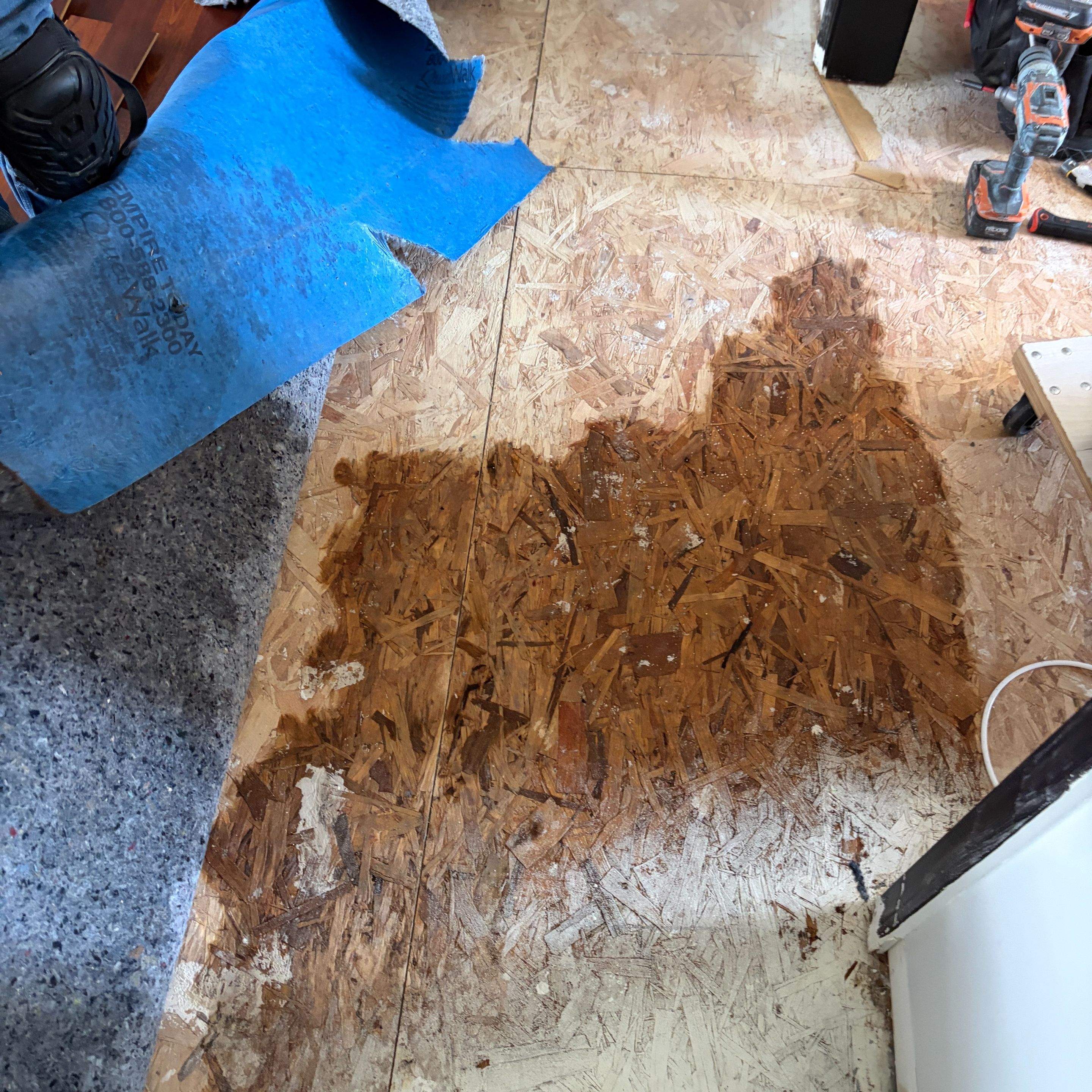
Problem 1: Mold Spores Are Already in Your Center Grove Home Waiting for Water
Most homeowners think mold contamination comes from outside. It does not. Mold spores exist in every building in Center Grove, dormant and harmless, until three things show up at once: moisture, an organic food source, and a temperature between roughly 60 and 80 degrees. Your drywall, carpet backing, cabinet particleboard, and wood framing are all food. Indoor temperatures sit in the growth range year round. The only missing ingredient is water. The moment a pipe bursts, a sump pump fails, or a storm pushes water through a window seal, the countdown begins.
What surprises clients most is how little water it takes. A damp baseboard with 16 percent moisture content is enough. You do not need standing water for mold to start, you need wet materials that stay wet. Common species like Aspergillus, Penicillium, and Cladosporium can germinate in 24 to 48 hours under the right conditions, while Stachybotrys (often called black mold) typically needs sustained saturation over 7 to 10 days. That window is exactly why the first two days after a leak matter so much.
Solution 1: Cut the Moisture Source Within the First 6 Hours
The single most useful thing you can do in the first hours after a water event is stop new water from entering and start removing what is already there. That means shutting off the supply valve to a leaking line, killing power to affected circuits if safe, and pulling standing water with whatever you have access to. If the source is unclear, our team at Center Grove Water Restoration can locate it during a free inspection, including hidden leaks behind walls or under flooring.
Here is the order that matters in those first hours:
- Stop the water source at the valve, the main, or by isolating the appliance.
- Remove standing water with a wet vacuum, pump, or professional water extraction service if the volume is more than a few gallons.
- Pull back soaked rugs, lift furniture onto blocks, and open cabinets so air can reach trapped moisture.
Document everything with photos before you move items or start drying. Your insurance carrier will want timestamped evidence of the loss condition, the source, and the steps you took to mitigate further damage. Skipping documentation is one of the most common reasons claims get reduced or denied in Center Grove.
Problem 2: Surface Drying Is Not Real Drying
This is where most Center Grove homeowners lose the race. They mop the floor, run a box fan for a day, feel the carpet, and decide it is dry. The problem is that water migrates downward and outward. Carpet pad holds water like a sponge. Subfloor wicks it sideways into walls. Insulation behind drywall stays saturated for weeks even when the painted surface feels cool and dry to the touch. By the time a musty smell appears, mold has typically been growing for 3 to 10 days inside materials you cannot see.
Moisture meters tell the real story. Wood framing is considered dry under 15 percent moisture content. Drywall should read under 1 percent on a non-penetrating meter. Without those readings, you are guessing. The musty odor itself is a chemical signal called MVOCs (microbial volatile organic compounds) that mold colonies release as they metabolize. If your nose detects it, the colony is already mature enough to off-gas.
Problem 3: Hidden Mold Behind Walls and Under Floors
Once mold establishes itself inside a wall cavity or under a vinyl plank floor, it does not stop. It feeds, releases spores into your air, and slowly degrades the material it grows on. Health symptoms in Center Grove families often start subtle: morning headaches, a child's worsening asthma, lingering sinus irritation that antihistamines do not touch. By the time visible black or green patches appear at outlets or along baseboards, the colony behind the wall is usually much larger than the surface stain suggests.
Pay attention to indirect clues too. Paint that bubbles or peels weeks after a leak, baseboards that pull slightly away from drywall, warped laminate seams, or a single room that always feels cooler and damper than the rest of the house. These are signs of trapped moisture even when no stain is visible.
Solution 2: Professional Drying Equipment in the First 24 to 48 Hours
The IICRC S500 standard exists because the industry learned, repeatedly, that household fans cannot create the airflow and dehumidification needed to dry building assemblies fast enough to beat mold. A standard restoration setup uses commercial air movers, low grain refrigerant or desiccant dehumidifiers, and air scrubbers with HEPA filtration running 24 hours a day. For a typical Center Grove basement loss, that might mean 6 to 12 air movers and 2 to 4 dehumidifiers running for 3 to 5 days. You can read more about the typical timeline in our breakdown of how long water damage takes to dry.
Three things separate professional drying from DIY:
- Equipment volume sized to the cubic footage and material type, not just one fan per room.
- Daily moisture monitoring with documented readings your insurance adjuster will want to see.
- Targeted demolition only where needed, so wet insulation comes out but dry drywall stays.
Solution 3: Get an Honest Assessment Before You Demo Anything
If you are past the 48 hour window and worried mold has already started, do not start ripping out drywall on your own. Disturbing contaminated material without containment spreads spores through your HVAC system and into rooms that were never affected. A proper assessment includes moisture mapping, thermal imaging, and in some cases air sampling. From there, the scope is either focused remediation or, if the moisture is gone and materials are dry, monitoring only. Our team explains the full process in our guide on mold after water damage removal and prevention, which covers what containment, HEPA filtration, and post-remediation verification actually involve.
The hard truth: every hour past 48 raises your remediation cost. A same day dry-out in Center Grove might run a few thousand dollars. A week-old loss with mold in walls and HVAC contamination can climb past 20,000 quickly. Speed is not just safety, it is money.