Why Kitchen Leaks Behave Differently Than Bathroom Leaks
Bathrooms are designed to get wet. Floors slope toward drains, walls are tiled, and most fixtures sit on waterproof pans. Kitchens are designed to look beautiful. Cabinets are particleboard with a thin veneer, toe kicks trap water against the subfloor, and the dishwasher sits in a recessed bay with no drainage. When water escapes a kitchen fixture, it has nowhere to go except into materials that absorb it greedily and then refuse to release it.
That absorption pattern is why we treat kitchen calls with a different mindset. A Center Grove homeowner can mop up a visible spill in ten minutes and assume the problem is solved. Three weeks later, the laminate near the dishwasher begins to lift, the cabinet base swells, and a faint sour smell starts coming from the cabinet under the sink. By then, the affected materials are not drying. They are decomposing. IICRC standards classify most kitchen losses as Category 2 once dishwasher residue, food particles, or stagnant drain water are involved, which means proper restoration requires antimicrobial treatment, not just fans.
There is also a layout problem unique to kitchens. The plumbing wall behind the sink usually backs up to either a dining room, a pantry, or an exterior wall with insulation packed tight against the studs. Water that escapes a supply line does not just sit under the cabinet, it wicks sideways into that insulation and upward into the drywall behind the backsplash. We have seen Center Grove homes where the visible damage was a six-inch wet ring around the P-trap, while the actual saturated footprint extended four feet into the adjacent room.
The Five Kitchen Leak Sources, Side by Side
The table below is the heart of this guide. It compares the five sources we see most often in Center Grove kitchens, the damage signature each one leaves, the typical IICRC category, and what professional restoration tends to run. Costs reflect typical central Indiana ranges for a single-room loss and assume catching the issue within the first week or two. Older or hidden leaks routinely double these figures.
| Leak Source | Typical Cause | Damage Signature | IICRC Category | Drying Time | Restoration Range |
|---|---|---|---|---|---|
| Sink supply line | Failed compression fitting or aging braided hose | Active drip or spray, fast saturation of cabinet base and adjacent flooring | Category 1 (clean) | 3 to 5 days | $1,200 to $3,500 |
| Sink drain or P-trap | Loose slip nut, cracked PVC, disposal seal failure | Slow accumulation in cabinet, swollen particleboard, sour odor | Category 2 (grey) | 4 to 7 days | $1,800 to $5,000 |
| Dishwasher supply or pump | Inlet valve failure, door gasket leak, pump seal break | Water under unit, warped flooring in front, wet wall behind | Category 2 | 5 to 8 days | $2,500 to $7,000 |
| Refrigerator ice maker line | Pierced poly tubing, loose saddle valve, frozen split | Hidden saturation behind fridge, subfloor damage, possible basement ceiling stain | Category 1 to 2 | 5 to 10 days | $2,000 to $8,500 |
| Garbage disposal body | Rusted-through housing, internal seal failure | Steady drip during use, cabinet bottom rot, mold colonization | Category 2 | 4 to 6 days | $1,500 to $4,500 |
Reading the Table Honestly
A few patterns deserve attention. First, the cheapest scenario, a sink supply line failure caught early, is also the easiest to spot because the leak is loud and visible. You will notice it. You will shut off the angle stop under the cabinet. The water is clean, the materials have not had time to delaminate, and a focused drying setup handles the loss in under a week. This is the kitchen leak you want, if you have to have one.
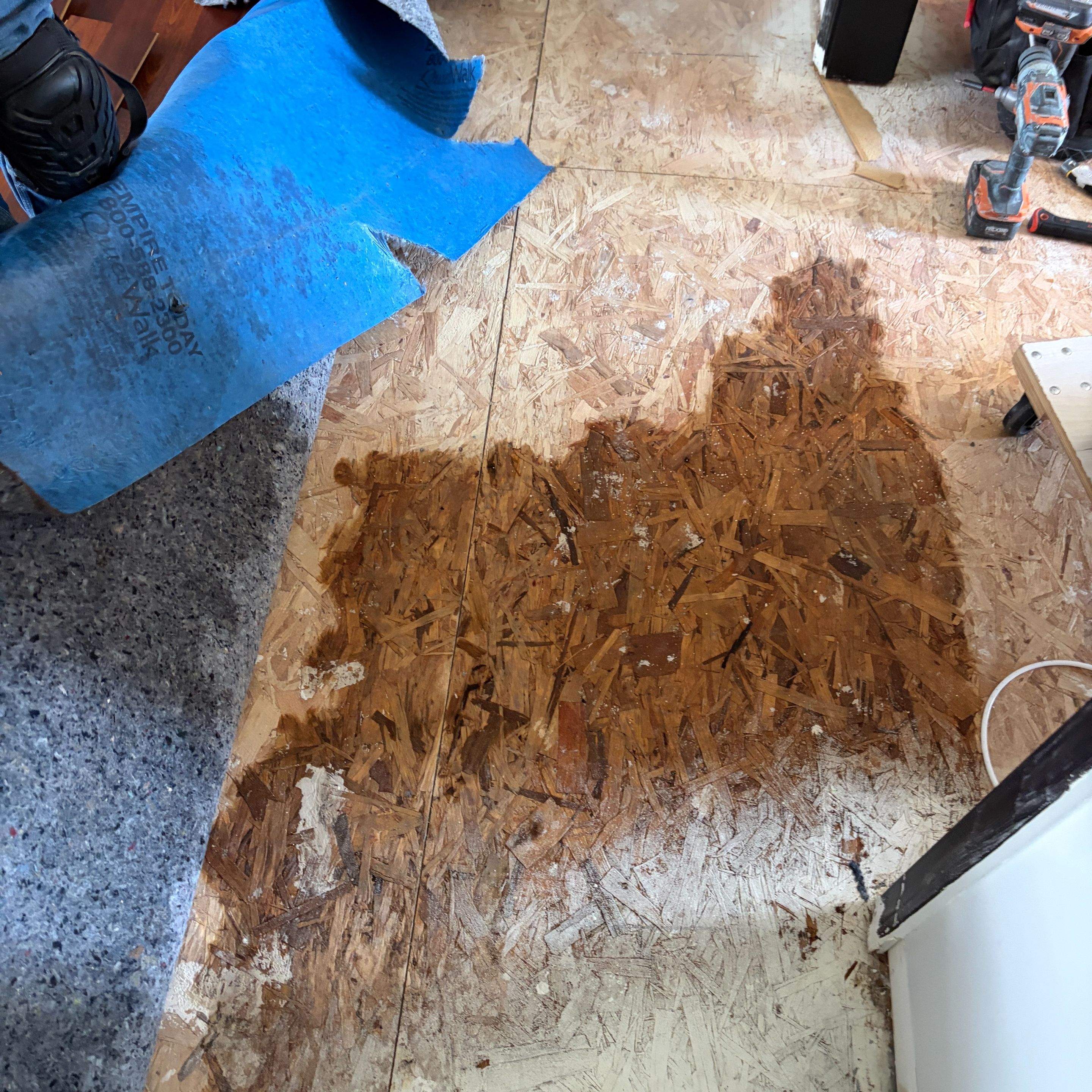
The expensive scenarios share a different trait. They are quiet. An ice maker line behind the refrigerator can drip a teaspoon per hour for six months before anyone moves the appliance. By that point, the subfloor underneath is spongy, the kitchen flooring is cupped, and water has likely traveled through the floor cavity into the room or basement below. We have walked into Center Grove kitchens where the original line repair was $40 and the resulting restoration ran north of $9,000 because the homeowner never thought to pull the fridge out. Our deeper look at subfloor water damage detection and repair cost goes into how we map this kind of hidden saturation.
Category matters too. Anything involving dishwasher residue, drain water, or disposal contents is automatically Category 2 under IICRC guidelines, which changes the cleaning protocol. We are not just drying materials, we are sanitizing them, and unsalvageable porous items like soaked cabinet bases and laminate planks need to be removed rather than dried in place. If you have read our piece on the dishwasher leak floor repair process, you already know why we are cautious about saving wet kickboards.
One more pattern worth naming. The restoration ranges in the table assume single-story damage with no migration into finished spaces below. If your kitchen sits over a finished basement, a family room ceiling, or a crawlspace with ductwork, add roughly 40 to 70 percent to every figure. Gravity does not care which appliance failed, and the ceiling assembly below a kitchen is one of the most expensive systems to reopen, dry, and refinish in a typical home.
What This Means for Your Next Move
If you are reading this with a wet kitchen floor right now, stop the source first. Turn off the angle stop under the sink, the dedicated valve for the dishwasher, or the saddle valve feeding the fridge. Pull the appliance out if you can do so safely. Photograph everything before you mop, because your insurance adjuster will ask. Then call a restoration company that will scope the loss with moisture meters rather than eyeballing it. Surface drying a kitchen without checking subfloor and wall cavity readings is how small claims become large ones, which is exactly the trap our water damage restoration team is built to prevent.
If the leak is not active right now but you suspect something is off, a damp smell, a soft spot near the dishwasher, a stain on the basement ceiling directly under the fridge, treat that suspicion seriously. Center Grove Water Restoration offers no-pressure moisture inspections for exactly this reason. Catching a slow kitchen leak in week two instead of month six is the single biggest factor in keeping your restoration affordable and your cabinets original.