The 7 Things You Need to Know Right Now
- Shut off the water source. Main valve, appliance valve, or the street shutoff.
- Kill power to wet areas at the breaker if it is safe to reach.
- Document everything with phone photos and short videos before you move items.
- Call a 24/7 IICRC firm like Center Grove Water Restoration for same-day mitigation in Center Grove.
- Call your insurance carrier and open a claim number.
- Move contents up and out of standing water if you can do it safely.
- Do not wait until morning. The 24 to 48 hour mold window is real.
Typical Water Damage Restoration Costs in Center Grove
Every loss is different, but most Center Grove jobs land in predictable ranges. Use these as planning numbers, not quotes.
- Small clean water loss (one room, Category 1): $1,200 to $3,500
- Average residential loss (multiple rooms or one finished basement zone): $3,500 to $8,000
- Large basement flood with pad and drywall removal: $8,000 to $15,000
- Category 2 gray water (washer overflow, dishwasher): add 20 to 35 percent
- Category 3 black water (sewage, river flooding): $7,000 to $25,000 or more
- Whole-home loss with multiple floors affected: $20,000 and up
Insurance often covers sudden and accidental losses. It rarely covers long-term seepage or unmaintained sump pumps. Our team helps you sort that out during the initial inspection.
What Drives the Price Up or Down
- Water category (1 clean, 2 gray, 3 black) per IICRC S500 standards
- Square footage of wet materials, not just the room size
- Class of loss (Class 1 minimal absorption to Class 4 deep saturation)
- Number of air movers and dehumidifiers needed and days on site
- Whether hardwood, engineered flooring, or carpet pad must come out
- Antimicrobial application for contamination risk
- Reconstruction scope after mitigation, which is billed separately
Red Flags That Mean Stop and Call a Pro
- Water from a toilet, drain line, or anything that touched the ground outside
- Sewage smell or visible solids (this is Category 3, full stop)
- Water touching electrical outlets, baseboards heaters, or HVAC returns
- Wet drywall over 48 inches up the wall
- Hardwood floors cupping or crowning within hours
- Musty smell already present (mold may already be active)
- HVAC ran while the area was wet (contamination spread risk)
If any of these match what you are seeing, do not run a shop vac and call it done. Category 3 losses and sewage backups need containment, PPE, and proper antimicrobial treatment. Our guide to Category 3 sewage emergencies explains why these jobs are not DIY.
Insurance Claim Mistakes to Avoid
- Throwing away damaged items before the adjuster sees them
- Cleaning up so thoroughly there is no evidence of the loss
- Signing a contractor agreement of protection without reading it
- Accepting the first estimate without a scope comparison
- Forgetting to claim contents (rugs, furniture, electronics)
- Missing the proof of loss deadline in your policy
Our team coordinates with adjusters every day. We will not tell you to file a claim if your deductible is higher than the loss, and we will tell you when filing makes sense. The water damage insurance claim walkthrough on our blog covers the paperwork side in detail.
The IICRC Drying Process, in 6 Stages
- Inspection and category determination. Source identification, scope, safety check.
- Water extraction. Removing standing water with truck-mount or portable units.
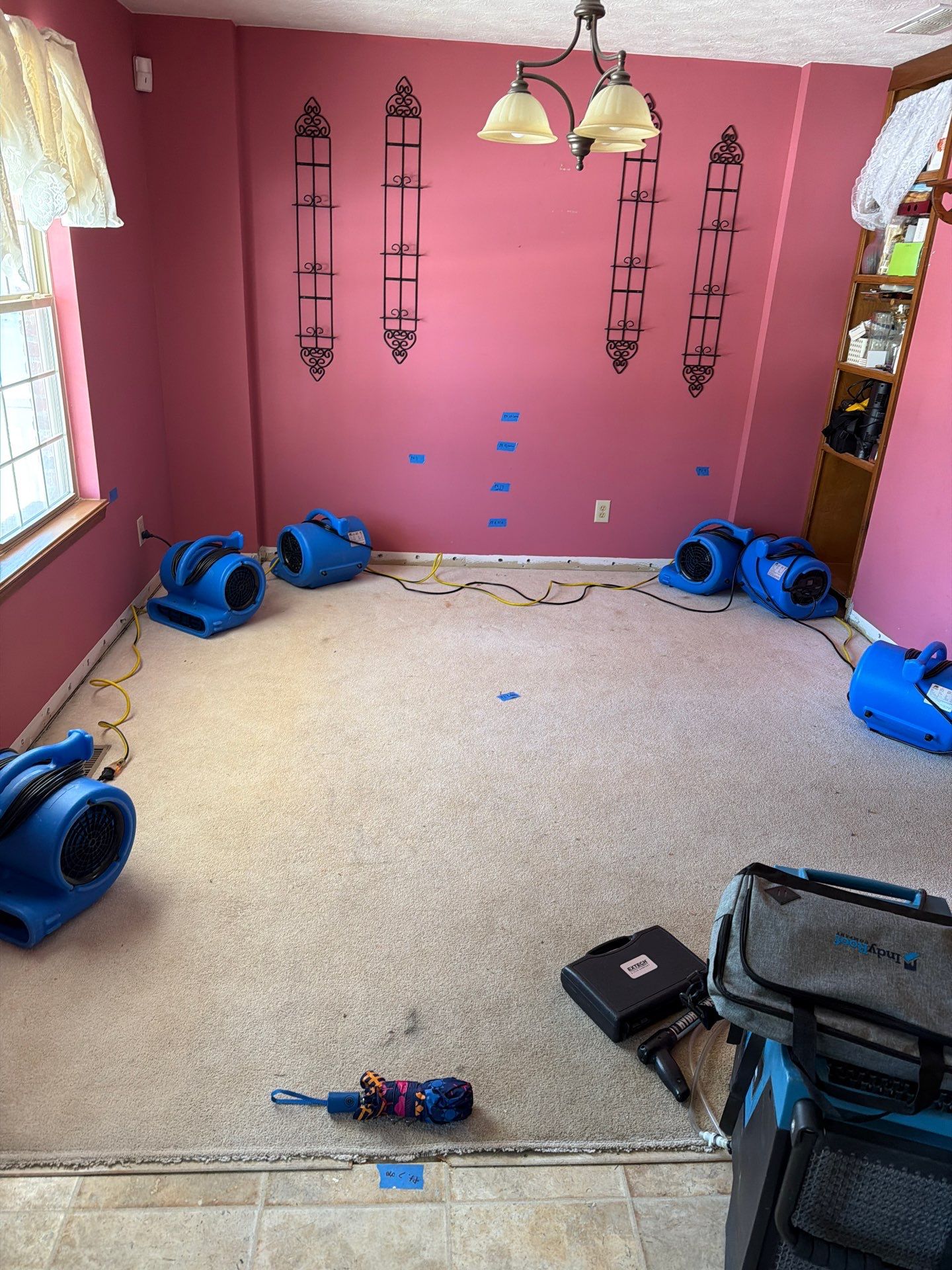
- Demolition as needed. Baseboard removal, drilling weep holes, lifting carpet pad.
- Drying setup. Air movers (one per 10 to 16 linear feet of wall) plus dehumidifiers sized to the affected cubic footage.
- Daily monitoring. Moisture readings logged for 3 to 5 days until materials hit dry standard.
- Final clearance. Equipment removal, post-mitigation report, reconstruction handoff.
How Center Grove Water Restoration Prices a Typical Center Grove Job
- Emergency service call and inspection: often covered under your claim
- Extraction billed per square foot of affected area
- Equipment billed per unit per day (air movers and dehumidifiers)
- Antimicrobial billed per square foot when contamination is present
- Content manipulation and pack-out billed by hour or by item count
- Reconstruction quoted separately after mitigation completes
Pricing follows Xactimate, the same software your insurance adjuster uses. That keeps the conversation honest and the numbers consistent.
Prevention Steps Worth Doing This Month
Most of the losses we respond to in Center Grove were preventable with 30 minutes of homeowner attention. Walk your home this weekend and check these.
- Replace rubber washing machine hoses with braided stainless steel (10 year life)
- Test your sump pump by pouring 5 gallons in the pit and confirming it cycles
- Install a battery backup sump or a water-powered backup for storm outages
- Add leak sensors near the water heater, dishwasher, and washing machine
- Know where your main shutoff valve is and turn it once a year so it does not seize
- Insulate pipes in unheated spaces before the first freeze
- Clean gutters twice a year and confirm downspouts discharge 6 feet from the foundation
- Have the water heater inspected at year 8 and budget for replacement at year 10
A $15 leak sensor on the floor next to your water heater can save you a $9,000 claim. That is the cheapest insurance you will ever buy. If you want a second set of eyes, Center Grove Water Restoration offers walkthrough assessments for Center Grove homeowners, and we will flag the risks before they turn into 2 a.m. phone calls.
Common Causes We See in Center Grove Homes
Knowing the source helps you tell the adjuster a clean story. These are the calls we run most often.
- Supply line failures. Toilet supply lines, ice maker lines, and washing machine hoses are the top three on our board.
- Frozen pipe bursts. Exterior walls, attics, and unheated crawlspaces during cold snaps.
- Sump pump failures. Power loss, stuck float, or a pump that finally quit after 10 years.
- Roof leaks. Wind-driven rain, ice dams, and failed flashing around chimneys or skylights.
- Water heater tank ruptures. Most tanks fail between year 8 and year 12.
- Dishwasher and refrigerator leaks. Slow drips that go undetected for weeks.
- Foundation seepage. Hydrostatic pressure after heavy rain or rapid snow melt.
- Sewer line backups. Tree roots, grease, or municipal main issues.
What 24/7 Emergency Service Actually Means at Center Grove Water Restoration
A lot of companies advertise 24/7. Fewer actually staff it. Here is what you should expect from any real emergency responder in Center Grove.
- A live human on the phone within 2 rings, not a voicemail
- Dispatch within 60 minutes for active flooding
- On-site arrival typically in 60 to 90 minutes across the Center Grove metro
- Truck-mounted or portable extraction running within 15 minutes of arrival
- Moisture mapping with calibrated meters, not guesswork
- Written scope and photo documentation for your insurance file
- Direct insurance billing when your policy allows it
Our crews carry the same equipment list on every truck so the second technician on scene is not waiting for the first. For more on what we do in the first hour, our first steps after water damage guide walks through the exact order of operations.
What to Ask Before You Hire Anyone in Center Grove
- Are you IICRC certified, and can you show the WRT card?
- Do you carry general liability and pollution coverage?
- Will you provide daily moisture logs?
- Do you bill insurance directly or do I pay and get reimbursed?
- What is your written guarantee on drying to standard?
- Who handles the rebuild, you or a separate contractor?
- Are you local to Center Grove or subcontracting from out of state?